I
The Blades Before the Name
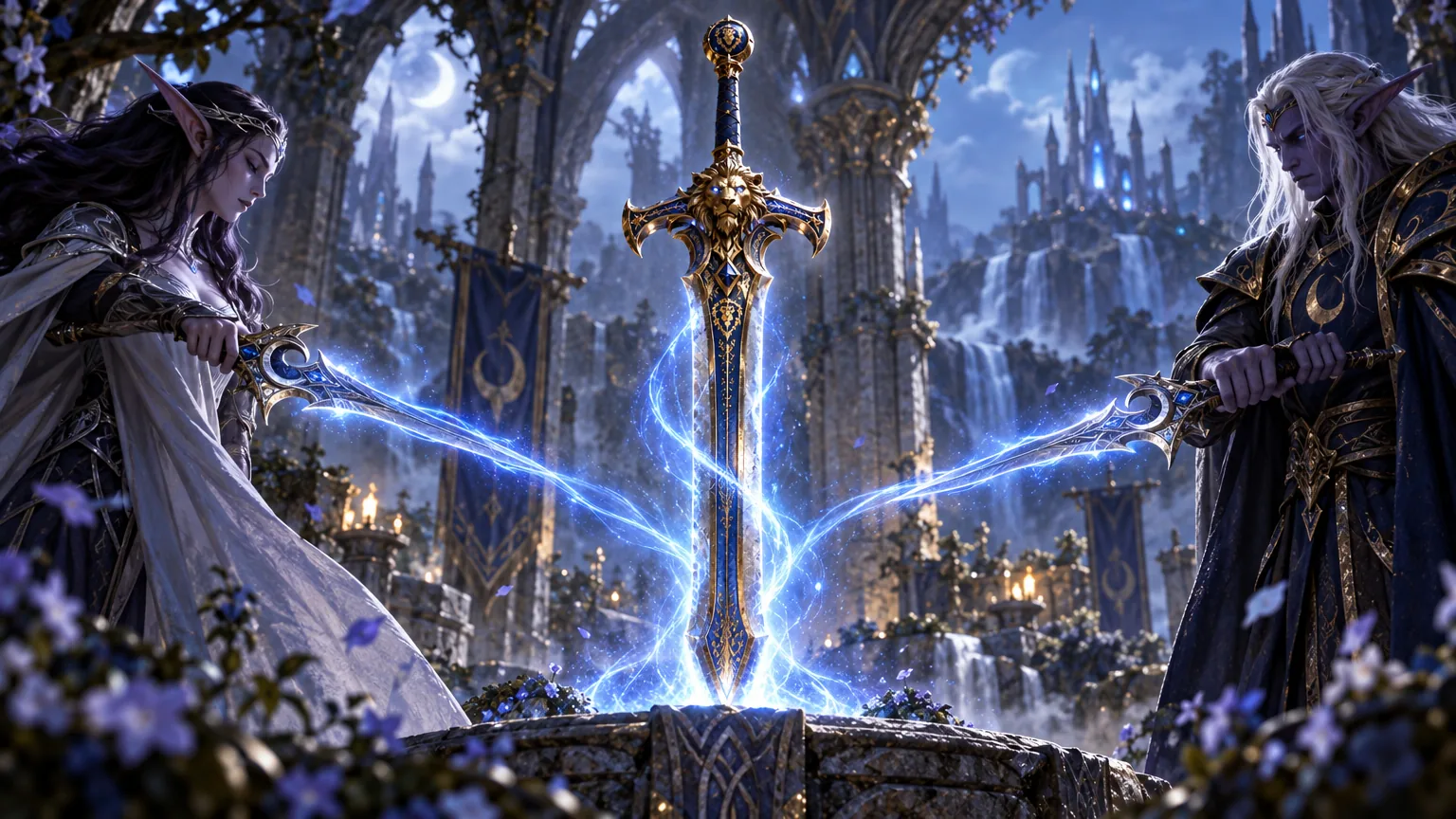
Before Shalamayne existed, there were two night elven blades: Shalla'tor and Ellemayne. They were distinct weapons, yet their eventual fusion made them parts of a single design. The name Shalamayne did not erase their separate identities. It preserved the idea that one weapon could contain two forms and move between them.
That dual nature would become the sword's defining quality. Many legendary weapons are broken and later repaired, but Shalamayne was not merely damaged when divided. Separation was part of what it was. The paired blades could answer different hands, different moments, and different kinds of conflict before returning to the shape of one great sword.
The weapon's earliest meaning therefore lies in possibility rather than ownership. Shalla'tor and Ellemayne existed before the royal symbol that followed. Their fusion created something recognisably new, but the two blades remained present inside it—two histories held together, ready to be separated again when the bearer required them.
II
A King Made Whole
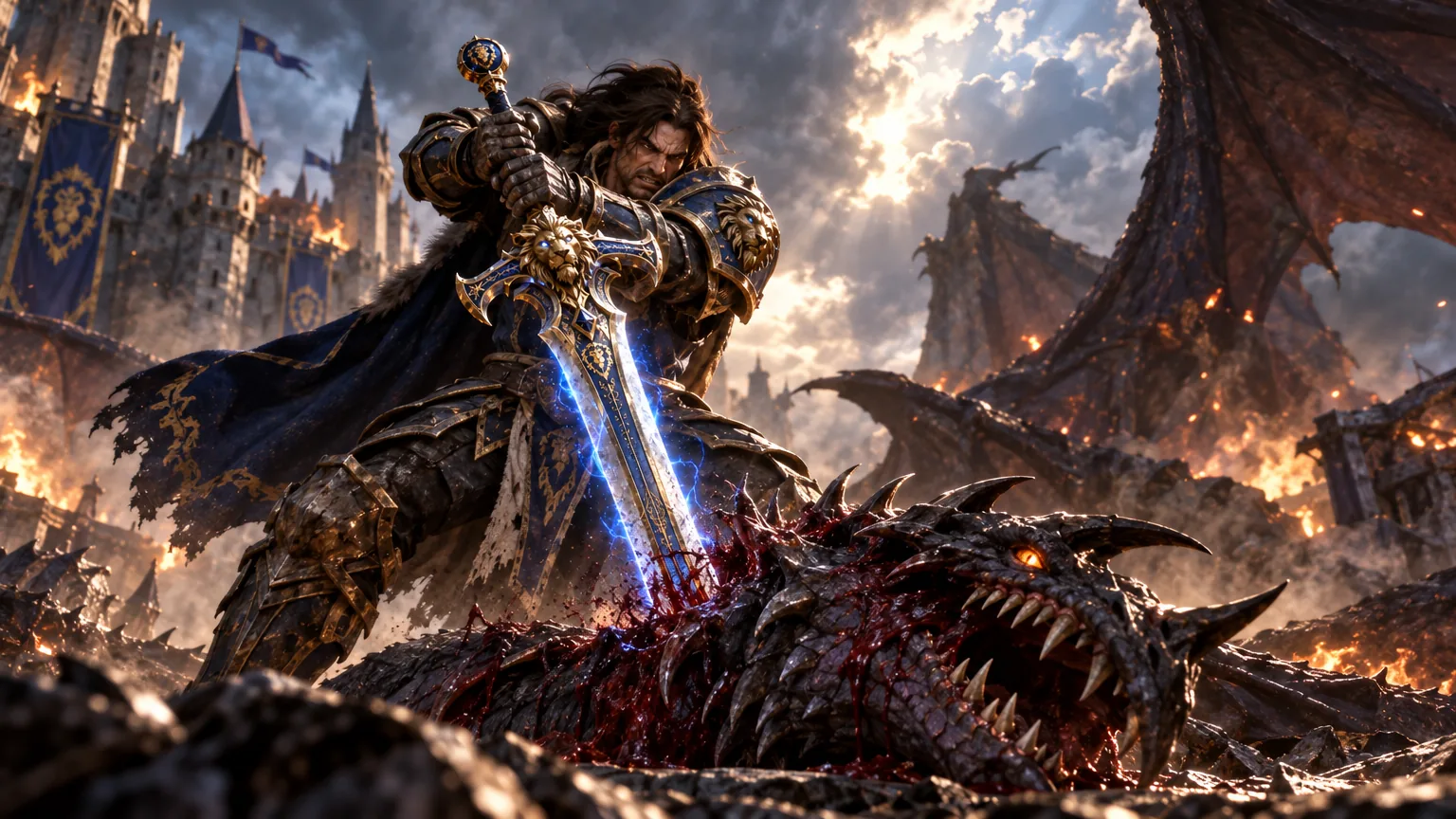
Shalamayne received its name and purpose during the confrontation with Onyxia. Varian Wrynn had been divided into two people. When Onyxia inadvertently reunited them and the two Varians became one person again, the paired swords followed the same transformation. Shalla'tor and Ellemayne fused into the single weapon that would be called Shalamayne.
The parallel is the heart of the blade's identity. Varian did not simply acquire a stronger sword after recovering himself. His weapon enacted the same resolution that he did. Two incomplete halves became one whole, and the result carried the memory of both states. Shalamayne was a physical expression of a king whose divided self had finally been reconciled.
Onyxia became the first target of the newly named sword. She tried to incinerate Varian, but he reached her head and impaled her with Shalamayne before beheading her. The blade's legend began not with a ceremonial presentation or an inheritance, but with the enemy present when the king's division finally ended.
From that moment, the sword and Varian were difficult to separate as symbols. Shalamayne represented his wholeness, his return, and the force with which he reclaimed his identity. Yet the weapon's ability to divide never disappeared. What had made it an image of restoration would later allow Varian to meet a very different final battle with a blade in each hand.
III
Light Extinguished on the Broken Shore
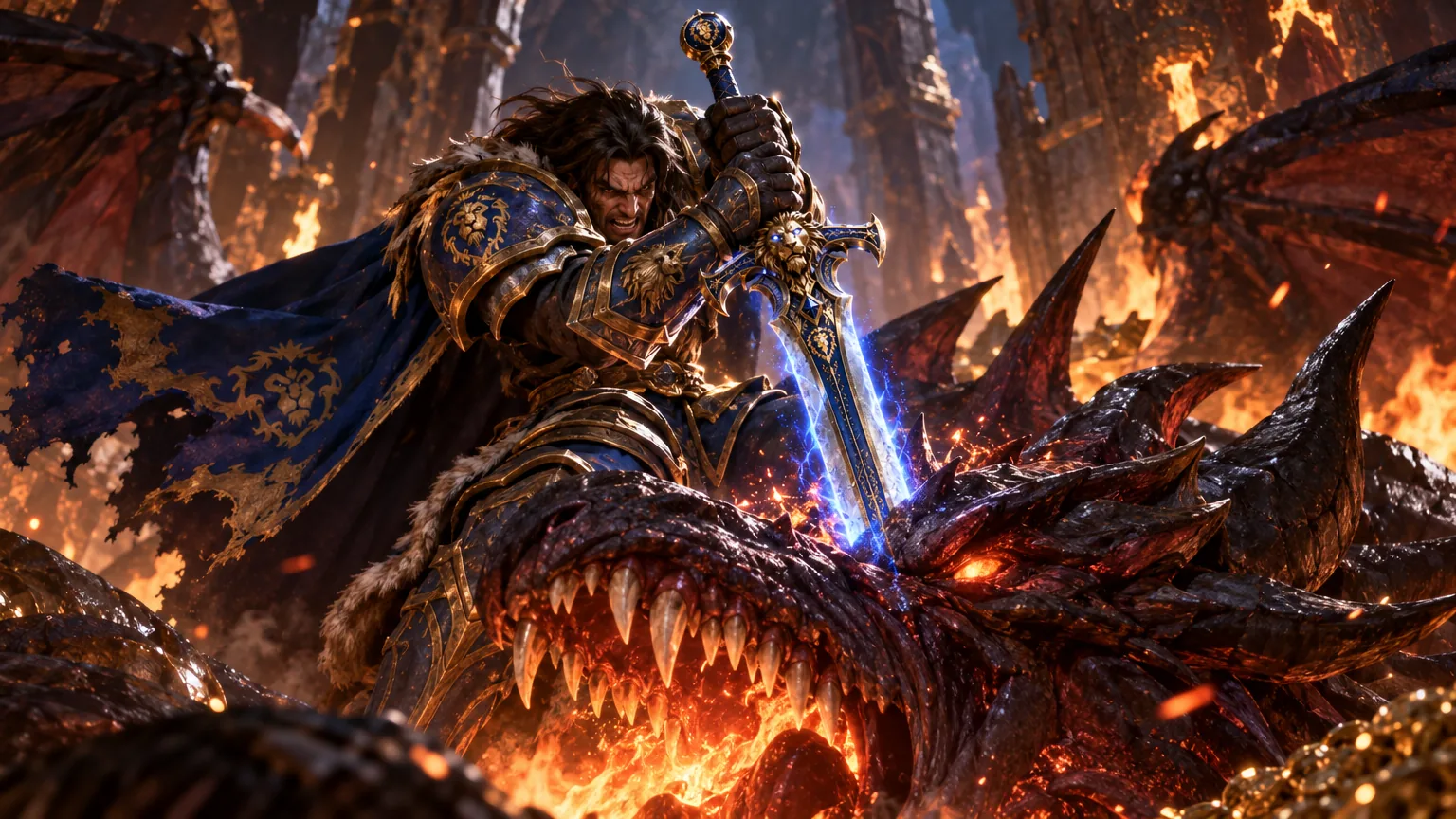
At the Broken Shore, Shalamayne returned to its paired form. Varian split the sword into two blades while fighting the Burning Legion, turning the unity that had marked his return into the flexibility he needed in battle. The act recalled the weapon's origin without undoing it: Shalla'tor and Ellemayne were still parts of Shalamayne even when they were no longer joined.
The battle ended with Varian's death. The divided swords were left behind in the sand, and the light within them went out. Their extinguished glow made the loss visible. Shalamayne had been born when Varian became whole; now, with its bearer gone, the weapon lay separated and darkened at the place where his story ended.
That image changed the sword's meaning. It was no longer only the triumphant weapon raised against Onyxia. It had become a memorial without a keeper. The same duality that once reflected a king restored now marked an absence: two blades, no hand to reunite them, and no light to announce the purpose they had carried.
The sword survived, but survival was not the same as continuation. For Shalamayne to become more than a relic left at Wrynnfall, someone would have to cross the distance between remembrance and inheritance. That task fell to Varian's son.
IV
The Inheritance at Wrynnfall
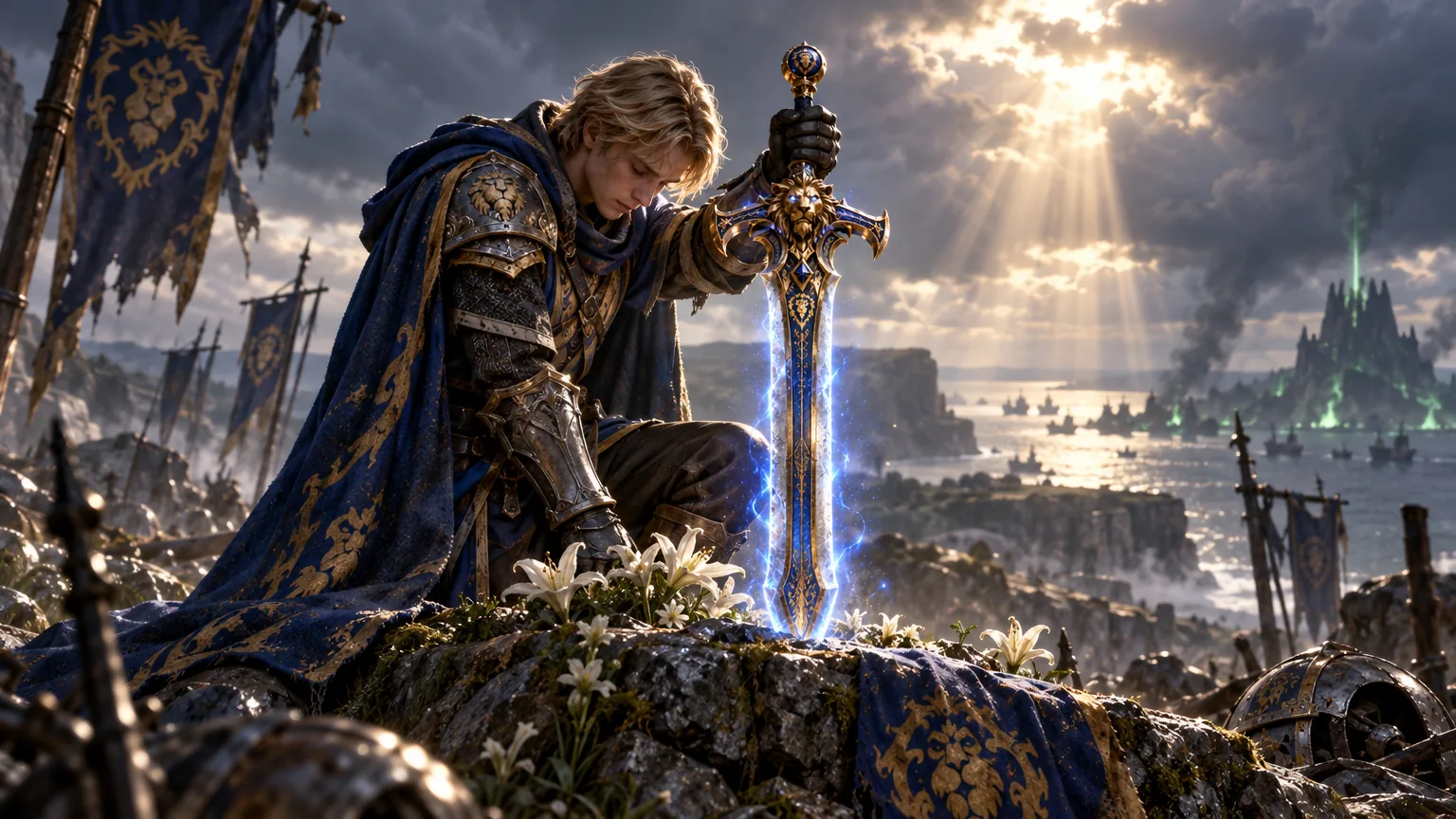
When the Armies of Legionfall began their assault on the Broken Shore, Anduin Wrynn left Stormwind and travelled to Wrynnfall, the place of his father's death. There he found Shalamayne. The recovery was not the public transfer of a royal heirloom. Anduin came to the place where the weapon had fallen and took up what Varian had left behind.
Shalamayne thus passed from father to son, but the inheritance did not make Anduin a copy of Varian. The young king was a priest who now carried a warrior's sword. The contrast was essential. He inherited the visible symbol of his father's strength while remaining a different kind of ruler, one whose relationship with the weapon could not simply repeat the past.
The sword made that tension impossible to hide. In Anduin's hands, Shalamayne joined identities that did not fit neatly together: priest and swordsman, son and king, memory and present duty. Its history already contained the union of two blades, so it was an unusually fitting weapon for a bearer learning to hold seemingly opposed parts of himself at once.
Wrynnfall also transformed the extinguished blades into a living inheritance. Varian's death remained part of the weapon, but it no longer left Shalamayne abandoned. Anduin carried the sword forward, giving the symbol a future that depended on his choices rather than on his father's reputation alone.
V
A Loan at Orgrimmar's Gates
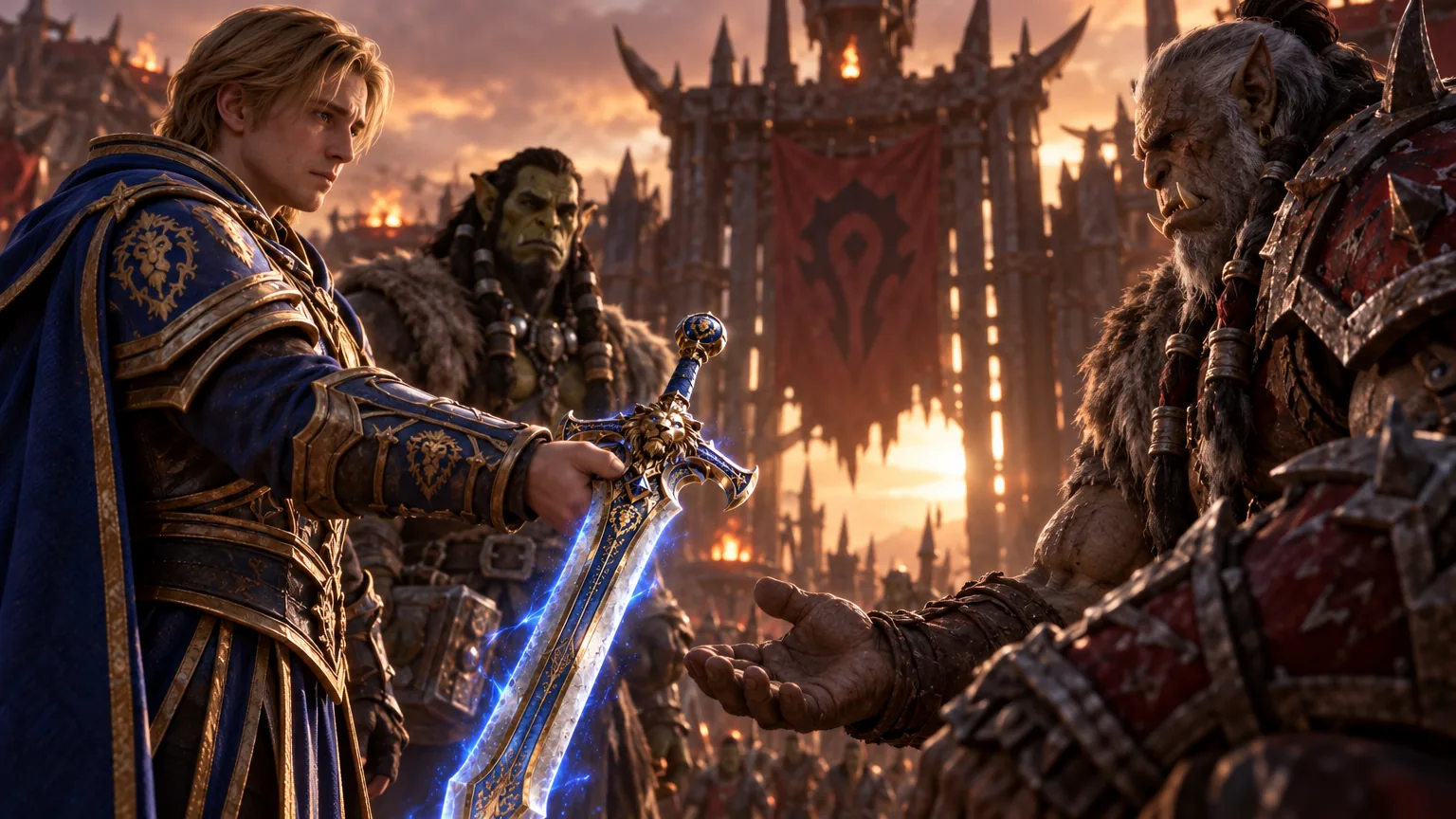
At the gates of Orgrimmar, Shalamayne passed briefly beyond the Wrynn line. Varok Saurfang prepared to face Sylvanas Windrunner in mak'gora. Anduin lent him Shalamayne, while Thrall gave him Dra'gora. The orc went into the challenge bearing weapons entrusted to him by two leaders whose hopes rested on what he was about to do.
The loan mattered because Anduin did not treat the sword as an untouchable royal possession. He placed the weapon associated with Varian's identity into Saurfang's hands. For that moment, Shalamayne served not bloodline but purpose. Its meaning could be shared when honour demanded action from someone other than its inherited bearer.
Saurfang's use of the blade also widened its legacy. Shalamayne had been formed with Varian, recovered by Anduin, and now carried by an orc at the centre of a conflict over the Horde's future. The sword crossed the political and personal boundaries that might have confined it. What began as the emblem of a human king became part of another warrior's final stand.
That passage would matter later, when Anduin needed to remember what the sword represented. Varian was not the only figure whose example remained attached to Shalamayne. Saurfang had carried it too, and the ideals associated with both men would eventually answer the darkness imposed on the blade.
VI
Kingsmourne and the Restoration
During Anduin's captivity in the Maw, the sword was taken into a form that reversed its earlier symbolism. The Jailer's blacksmiths reforged Shalamayne into Kingsmourne, a mourneblade containing the soul of Arthas Menethil, the former Lich King. A weapon once defined by a divided man becoming whole was remade as an instrument of domination.
The change was more than a new name or appearance. Kingsmourne turned inheritance into captivity. Shalamayne had passed willingly from Varian to Anduin and, for a time, from Anduin to Saurfang. Its reforging in the Maw denied that freedom. The sword and its bearer were both drawn into the Jailer's control, while the presence of Arthas's soul bound another history of kingship and ruin into the weapon.
Yet Kingsmourne did not become Shalamayne's final identity. When Anduin freed himself from the Jailer's grasp, he restored the sword. The act reversed the corruption, but it did not pretend that nothing had happened. Shalamayne returned without the light that had once shone within its hilt.
That absence is one of the most important details in the blade's story. Restoration did not mean a perfect return to an earlier state. The sword was itself again, but altered by what it had endured. Like its bearers, it could be reclaimed without being untouched. The darkness did not own its future, yet the cost remained visible.
VII
Valor, Honor, and the Sword's Legacy
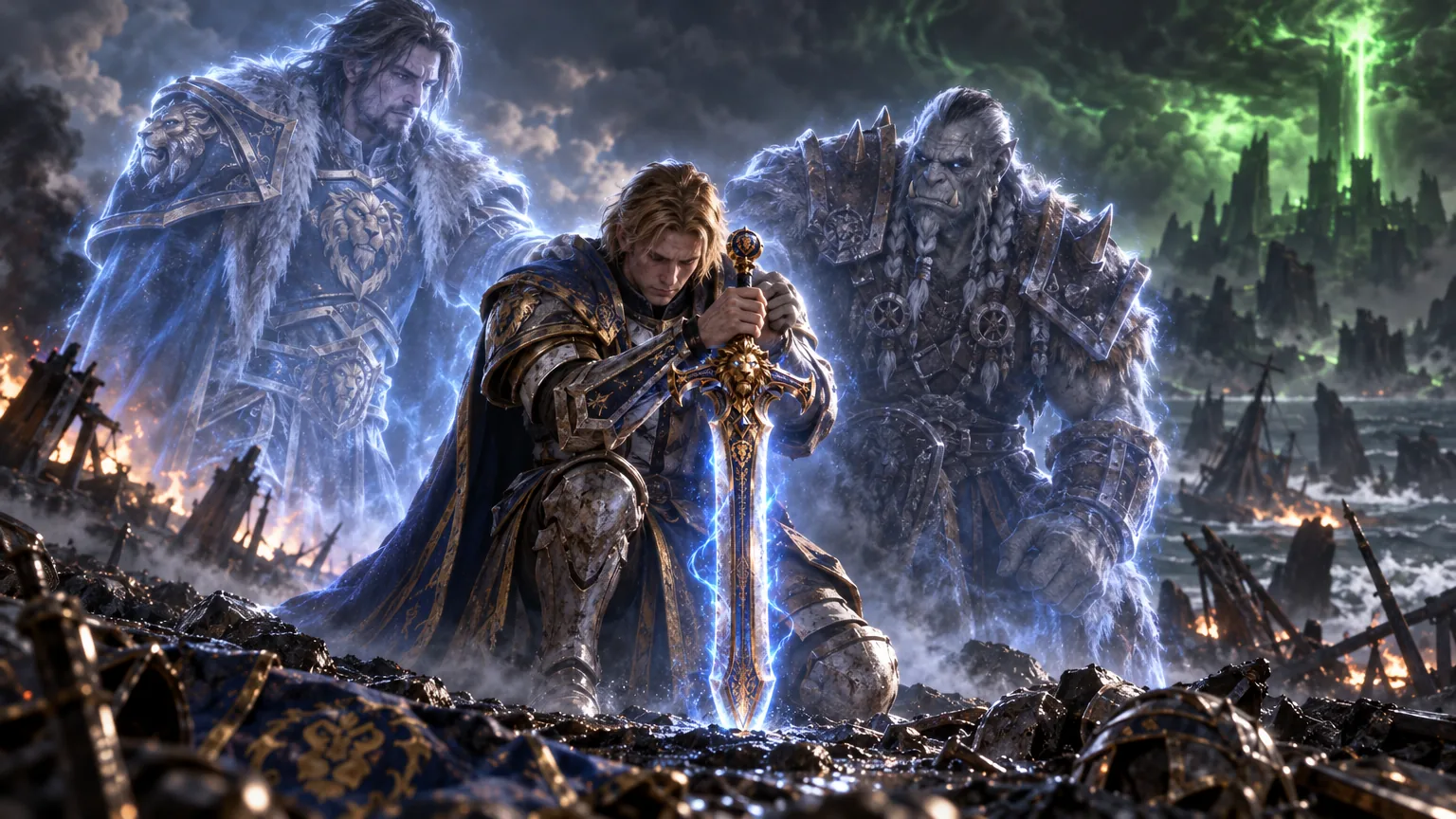
At the moment Anduin confronted what Shalamayne had become, the sword's meaning was answered by the two men most closely joined to its legacy. Varian appeared beside his son and reminded him that the blade had not been forged by darkness, but by valor. Varok Saurfang appeared at Anduin's other side and added honor.
Those words gathered the weapon's history into a final statement. Valor recalled the king who had become whole, slain Onyxia, and carried the sword to the Broken Shore. Honor recalled the warrior who had accepted Shalamayne at Orgrimmar's gates and used it in a cause larger than himself. Neither man defined the blade through ownership. They defined it through the choices made while carrying it.
Shalamayne's legacy is therefore not purity. The sword was split, abandoned, inherited, loaned, corrupted, and restored. Its light could be extinguished. Its form could be forced into Kingsmourne. Even so, darkness could not retroactively decide why the weapon had first been forged or what its bearers had made it represent.
That is why Shalamayne endures as more than a royal sword. It is a weapon whose physical nature mirrors its history: two blades that can become one, an inheritance capable of crossing boundaries, and a symbol that survives transformation without denying it. Varian gave it valor. Saurfang added honor. Anduin's task was not to preserve it unchanged, but to carry those meanings forward after both sword and bearer had passed through darkness.
The Passage of Shalamayne
Two blades. Eight turning points.
- Shalla'tor & EllemayneTwo night elven blades
- Varian made wholeShalamayne is formed
- Onyxia fallsThe first target
- Broken ShoreThe light goes out
- Anduin inheritsWrynnfall
- Saurfang carries itOrgrimmar's gates
- KingsmourneReforged in the Maw
- RestoredValor and honor endure
Questions from the archive
FAQ
What swords formed Shalamayne?
Shalla'tor and Ellemayne, two night elven blades, were magically fused into Shalamayne.
Who first wielded Shalamayne?
Varian Wrynn wielded the newly fused sword and used it against Onyxia.
How did Anduin obtain Shalamayne?
He travelled to Wrynnfall on the Broken Shore and recovered the blades left behind after Varian's death.
Why did Saurfang carry Shalamayne?
Anduin lent it to him for the mak'gora against Sylvanas Windrunner at the gates of Orgrimmar.
What was Kingsmourne?
Kingsmourne was the mourneblade created when the Jailer's blacksmiths reforged Shalamayne during Anduin's captivity. Anduin later restored the sword, though its hilt no longer held its former light.
Watch the Story
Shalamayne: The Sword Born When a King Became Whole
Watch the story of the sword that passed from Varian to Anduin, carried Saurfang into his final challenge, and returned from the darkness of Kingsmourne.
Continue through the armoury with Frostmourne, or follow the warrior who carried Shalamayne in Saurfang's final story.